


🎊 CELEBRATE NEW YEAR 2026 IN & NEAR 🗼 TOKYO
in most of the time , i prefer being alone . but i had longed celebrating [2025➠2026 New Year’s Eve] in [Tokyo] , expecting lights on skyscrapers and crowds in streets .
why ? i had not even bothered to think about “ why ” before i planned my itinerary . the opening of [ 📖 [Plato]’s « The Republic » ] mentions that [Socrates] went to a place to see how the local people there would celebrate a festival , and got delighted with the procession — look , even [Socrates] could not help but be attracted by something new to him . 😜
💭 in retrospect , i do have some thoughts & theories on why people celebrate new year ; i will discuss it in this article .
my itinerary
i planned to watch the night city on [Tokyo SkyTree] in the evening and join in the crowd in [Shibuya 渋谷] around midnight .
[Tokyo SkyTree] is currently the tallest structure in [Tokyo] ; it serves as both a radio transmission tower and a popular tourist attraction that offers a spectacular bird's‐eye view of [Tokyo] .
[Shibuya] , in terms of administrative divisions , is one of [Tokyo]’s 23 wards ; however , in most contexts , when people mention “ Shibuya ” , they are talking about a relatively smaller area within [city_ward: Shibuya] , just around [🚉 Shibuya Station 渋谷駅] — it is [Tokyo]’s most lively commercial district ,, where shopping malls rise skyward , roads & railways crisscross , neon signs glow & flash , and pedestrians bustle about . [🚉 Shibuya Station] is the world’s 🥈 second busiest station . in front of the station , there is a complex intersection , commonly called “ Shibuya Crossing ” ; it is said to be the world’s 🥇 busiest intersection ,, as it is estimated that , at peak times , more than two thousand people 2️⃣0️⃣0️⃣0️⃣➕ 🚶 cross it during each 🚦🔃 traffic light cycle .
fun fact : the world’s 🥇 busiest station is [🚉 Shinjuku Station 新宿駅] , just 3.5km north to [🚉 Shibuya Station] .
[🚥 Shibuya Crossing] became a place of massive gathering for celebrating new year since [New Year's Eve 2016➠2017] ; in the following years , as more and more people took part in this event , it soon became a global event . it was estimated that more than 140000 peple gathered and celebrated [2018➠2019 New Year's Eve] at this intersection . 📺 i first heard about this event around [2018] from global news ; since then , i longed for a visit .
readers may search online “ Shibuya Crossing New Year’s Eve celebration ” photos to get a general visual idea of what it looked like when more than one hundred thousand people gathered around a single intersection . i avoid using other people’s photo in my article .
unfortunately , the event was officially cancelled for [New Year's Eve 2020➠2021] because of the pandemic ,, but since then , it has never officially resumed , with various excuses given every year .
🤷
in [2025.12] , when i was planning for the trip , i learned that this year's event had been officially cancelled , again , for the sixth year in a row ; however , i also learned that non‐official celebration had actually always been occurring over years , though the scale was much smaller than those before the pandemic . 🫤 i decided to go check it out anyway .
🕛🎊 after the midnight celebration in [Shibuya] , i was to take a special train from [Tokyo] to the coast east of [Tokyo] to watch new year’s 🌅 sunrise . 🚄 this train service was specially arranged in the early morning of [2026‒01‒01] specifically for people traveling from [Tokyo] to the east coast .
😑 i made nearly no plan for the activities at the coast because i knew that many factors , especially the weather , could throw any plans off course ; instead , i decided to let everything unfold naturally .
📸🚶🎒

[Tokyo SkyTree]
i arrived at [Tokyo SkyTree] in the afternoon , expecting to get onto the observation deck before evening so that i could watch the last sunset of [2025] . but i miscalculated 🤦 : this site turned out to be so popular that the earliest tickets available were for 17:00 — given that sunset on that day in [Tokyo] was at 16:37 , it was no longer possible for me to see the sunset on the deck .
🕝
after getting the ticket , i had more than two hours before i could enter . 🚶 i took a detour to [🛕 Senso Ji 浅草寺 ( aka Asakusa Temple )] , not far away from [Tokyo SkyTree] .
[🛕 Asakusa Temple] was not in my itinerary though i knew it was a popular tourist destination .
its most iconic feature is huge red lanterns hanging from its gates .
🏮
even if you have never been to [Japan] , you have probably ever seen this temple ,, as photos or short video clips of its huge red lanterns , along with the bustle market in front of it , are often used as a symbol of [Japan]'s culture , embedded in articles or longer videos on related topics .
🕟
earlier in the evening , i walked back from the temple towards [Tokyo SkyTree] .

[Tokyo SkyTree] , seen through an alley , in evening .
see how tall it is in contrast to the vehicles and people on the ground . i could not even capture the top part of it in this photo .
🕠
once inside the building , visitors still had to wait in long lines for the elevators .

visitors waiting in long lines in front of the elevators before getting onto the deck .
faces in this photo have been blurred for privacy .
🕕
by the time i got onto the observation deck , the sky had been completely dark .
at the moment i saw the night view of the city below , i was captivated by its breaktaking beauty .

night [Tokyo] , seen on [Tokyo SkyTree] ( towards north ) .
on the photo , there are some fiant reflections of the indoor lighting ; that was difficult to avoid under the shooting condition at the time .
it was surprisingly quiet — you could not hear any noise from the should‐be noisy streets below . watching the cars and pedestrians move silently , it felt as if i were observing the world from another dimension .

night [Tokyo] , seen on [Tokyo SkyTree] ( towards west ) .
[🛕 Asakusa Temple] can be seen on this photo .
[🛕 Asakusa Temple] i just visited a few hours ago can now be seen from above .
watching a vibrant city on a tall tower is a unique experience . it feels different from watching the ground on a 🛬 plane ,, in that when a plane is flying at a height where the objects on the ground can be clearly seen , the plane has to keep a relatively high velocity against the ground , making it not feasible to track a particular object or a small area for long time . it also feels different from watching a city on a ⛰️ hill next to the city , as hills usually have slopes — the taller the hill , the longer the slope , the farther the city . in both scenarios , on a plane or on a hill , you may enjoy the whole picture , but you probably have to miss the details ; however , it is the dynamic details of a city that really make such experience fun . every car driving down the street , every room with a light on , is a story developing . how fascinating it is when thousands of stories unfold before your eyes , simultaneously and intertwiningly !
😃

night [Tokyo] , seen on [Tokyo SkyTree] ( towards east ) .
why do people like bird's‐eye view ?
🤔
for most people , getting bird's‐eye view is a fresh experience . because of gravity ,, humans , like most living things , live near [Earth]'s surface . because of gravity ,, naturally , on [Earth] , the elevation of one place is usually not much higher than that of the surrounding area . and , again , because of gravity ,,, even if there is a hill right next to a plain ,, most people will live on the plain , rather than on that hill ,, as water tend to flow to lower places and it is easier to carry out economic activities on the flat land .
in order to get bird's‐eye view , in order to get to and stay on a relatively higher place ,, additional investments are required . to reach the summit , climbers must expend physical energy ; to settle on a hill , people have to build infrastructure at a higher cost than they would on flat land . to build a structure in a city that towers far above all surrounding buildings , you need top‐notch materials and technologies ,, and to get on that structure for bird's‐eye view , you have to pay top‐notch price for the ticket 😂 .
in essence , features more desirable than the norm always entail costs higher than average ,, because if not , those features would have been new norms .
gravity is a norm of the universe , and going against it demands extra energy ; everyone being similar to others is a norm of the society ( and biology ) , so being superior to others requires extraordinary quality .
finally , getting bird's‐eye view is a reward of all the investments paid , in various forms .
😔

looking towards [🗼 Tokyo Tower] on [Tokyo SkyTree] .
[🗼 Tokyo Tower] was built in [1958] , originally designed as an antenna for telecommunications ; at the time of its completion , it was the tallest freestanding tower in the world , standing at 333 meters . according to official information publicly available , this height was determined both by considerations related to radio technology and by a deliberate effort to surpass [Eiffel Tower] .
U+1F5FC[U+1F5FC]‘Unicode’® ‘emoji’® character U+1F5FC , officially defined as TOKYO TOWER
.
you might not be aware that the ‘Unicode’® ‘emoji’® character [U+1F5FC] is actually officially defined as TOKYO TOWER
, rather than “ Eiffel Tower ” .
as far as i know , on social media , many users from [Tokyo] simply enter this single ‘emoji’® character ‘🗼’ in their profiles to indicate that they are from [Tokyo] . i understand that people must feel proud when their hometown's landmark has its own dedicated ‘Unicode’® character .
🥇🥈
[Tokyo Tower] remained [Tokyo]'s tallest landmark until [Tokyo SkyTree] reached structural completion in [2011] . today , when you look at [Tokyo Tower] from [Tokyo SkyTree]'s upper observation deck , you have to tilt your head slightly downward .
during my visit , i stood there for quite a while , gazing at [Tokyo Tower] .
👀
it still looks elegant , but it is no longer the tallest . with the lighthearted music playing in background , it feels as though such a surpassing was so effortless , so natural , yet utterly unstoppable .
just a few days ago , i happened to capture a special photo of [Tokyo SkyTree] .
📸

looking due north towards [Tokyo SkyTree] from 60km away on a boat crossing [Tokyo Bay] .
to the left of [Tokyo SkyTree] was the cluster of buildings of [Tokyo] city center , along with the glow of their lights .
the scattered lights low in the sky were from planes taking off and landing at [Haneda Airport 羽田空港] , while specks of light high in the sky were stars .
at the moment , [Tokyo SkyTree] was approximantely 60km directly north of me ,, and i was on a ferry boat crossing [Tokyo Bay] .
⛴️ 🧭

a schematic illustration of the shooting location and angle of the photo of [Tokyo SkyTree] seen from due south 60km away .
the map is from [OpenStreetMap] .
the field‐of‐view is derived from the camera sensor size and the lens focal length .
in that evening , the weather condition was excellent , and the visibility was very high . planes taking off and landing at [Haneda Airport] could be clearly seen .
however , when i was taking this photo , only [Tokyo SkyTree] was distinguishable to naked eye ; other buildings in the city center were difficult to make out because they were clustered together in the glow . although the images of the planes and stars in the sky were technically smaller in size than those of the buildings , planes and stars were actually easier to distinguish because their bright light stood out against the dark background .
but , amazingly and surprisingly , as i zoomed in on this photo , i found that [Tokyo Tower] was also distinguishable .
🧐

zoom in on the photo of [Tokyo SkyTree] taken from 60km away . see that [Tokyo Tower] is also distinguishable .
some structures in this photo appear to be taller than [Tokyo Tower] merely because they were closer to the camera ; in fact , [Tokyo Tower] was the second‐tallest structure in [Tokyo] , second only to [Tokyo SkyTree] .
is [Tokyo SkyTree] or [Tokyo Tower] a skyscraper ?
in those online lists or articles of tallest structures in the world , “ towers ” are usually labelled separately from “ skyscrapers ” .
in english , the term ‘skyscraper’ is defined as “ a very tall building ” ; however , the term ‘building’ , given its etymology , refers to “ a usually roofed and walled structure ” . a “ tower ” , therefore , may not be a building because most of its structure may not be “ roofed and walled ” .
albeit { it is strange that you can legitimately say “ build a tower ” , but a tower may not at all be a building } ,, i defer to the conclusion that { a tower may not be a building } because i acknowledge that it may be necessary in the field of architecture to distinguish between these two types of structures .
here , i seek to challenge the traditional understanding of the concept of “ skyscraper ” . i propose that the term ‘skyscraper’ should not be limited to a narrow category of buildings ; instead , it should straightforwardly refer to any object that can figuratively scrape the sky ,, and i interpret the word ‘scrape’ here as “ reaching towards the sky ( as seen from ground level ) in a purposeful manner with considerable strength & precision ” . according to this definition , a very tall building ( or any type of structure ) is a skyscraper , a plane flying in the sky is a skyscraper , a rocket flying towards the space is a skyscraper ; however , a balloon released to ascend to the sky may not be eligible to be called a skyscraper because it lacks strength and precision .
after widening the scope of skyscraper ,, i coin a new word : ‘sky‐scraping’ , which means “ an instance of an object ( or the phenomenon of objects ) figuratively scraping the sky ” .
i point out that sky‐scraping is a phenomenon of civilization .
in old times , towering turrets helped defend castles , soaring pinnacles symbolized the faith of the congregation ; nowadays , fighter jets streaking the sky secure a strategic advantage for a state , and tall structures in a city demonstrate the confidence of an economy . for a civilization ,, the higher they aim to go , the more advanced technologies they must acquire , the more energy they must mobilize ; but sky‐scraping is generally rewarding : the higher they reach , the greater the rewards they will harvest . in the future ,,, we will take off from this ground , fly away from this sky ,, and eventually reach another ground , looking to another sky .
🚀

night [Tokyo] , seen on [Tokyo SkyTree] ( towards south ) .
the brightest part is [🚉 Kinshichō Station 錦糸町駅] and shopping malls around it , while the dark part in the distance is [🌊 Tokyo Bay] .
coincidently , [🚉 Kinshichō Station] would be the place i was going to , in about eight hours , board the special train bounding for the coast east of [Tokyo] to watch the sunrise tomorrow early morning . but before that , i would visit [Shibuya] first to celebrate the 🕛 midnight moment .
the dark body of water in the distance in this photo is [🌊 Tokyo Bay] — it was from a point 60km away within that darkness that i captured that amazing photo .
🧑🏫 QUIZ
to the south of [Tokyo SkyTree] and north of [Tokyo Bay] lies a large urban area with many buildings and lights ,, but why were these buildings & lights almost not visible when i was looking north towards [Tokyo SkyTree] from 60km away ?
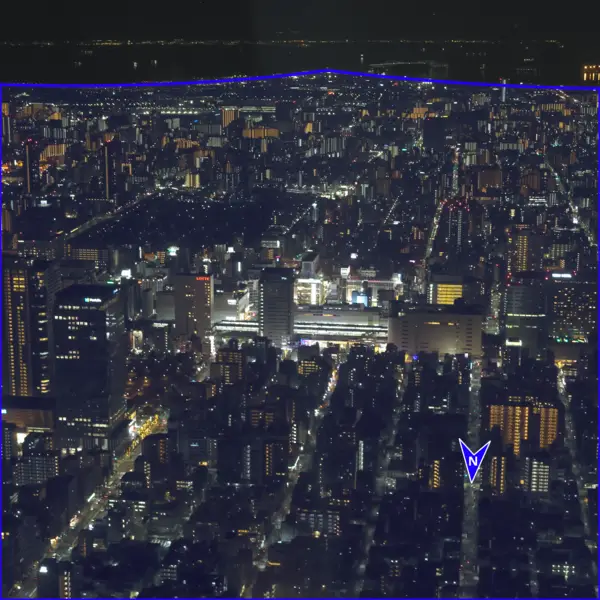
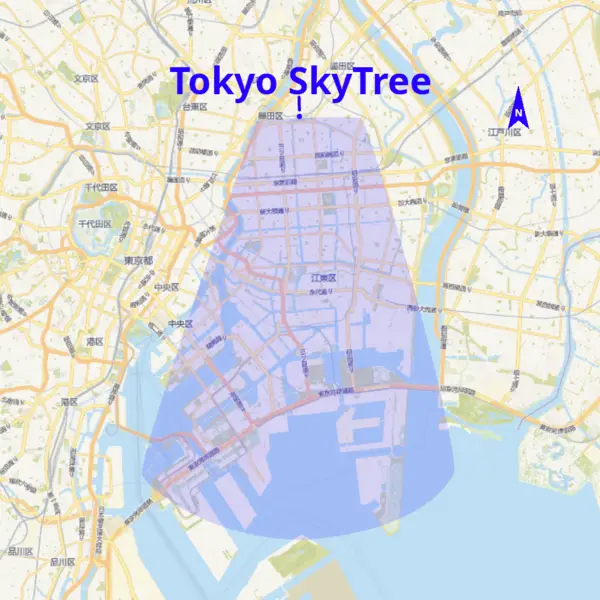
the previous photo and map show that to the south of [Tokyo SkyTree] and north of [Tokyo Bay] lies a large urban area ( marked by the blue tint ) .
the map is from [OpenStreetMap] .
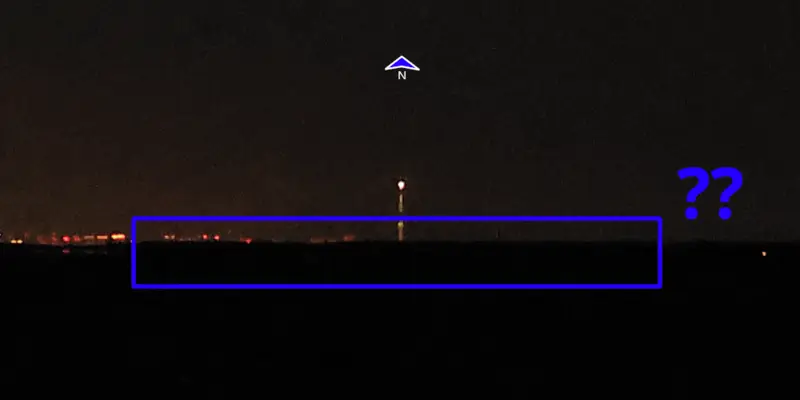
it appears to be strange that the urban area cannot be seen on the previous photo of [Tokyo SkyTree] seen from due south 60km away .
🤔
🕘
it is time to head to the next venue : [Shibuya] !

bye , [SkyTree] ~ see you next time !
👋
💡 QUIZ ANSWER
[Earth] is spherical .
let [Earth]'s center be O , its radius be ; here , we take .
let the point on [Earth]'s surface where [Tokyo SkyTree] stands be A , and my standing point on [Earth]'s surface in [Tokyo Bay] be B , the spherical distance between A and B be ; in reality , .
is an angle at the spherical center .
let the top of [Tokyo SkyTree] be T , then AT represents [Tokyo SkyTree] ; .
when standing at point B , looking towards AT ,, the line of sight is tangent to the sphere , perpendicular to the line linking [Earth]'s center O and point B .
let S be the point at which the line of sight intersects AT . note that AS is not visible from point B because this segment will be below the horizon from that distance .
next , we are going to calculate the length of AS to see exactly how much of the tower is not visible from point B .
since is a right triangle , with ,, we have and ( of course , ) .
that means that when standing at a point 60km away from [Tokyo SkyTree] , looking towards it , you actually cannot see the part of the tower below 283m in elevation .
using the same method , we can calculate : for an object at the southmost point of the coastline south of [Tokyo SkyTree] ( marked as C ) , how tall must it be in order to be visible at point B . in real world ,, the spherical distance between A and C is about 14km , while the spherical distance between B and C is about 46km .
imagine a ray originating from O and passing through C ; such a ray will intersect the line of sight BS ; mark the point of intersection as Q . CQ is not visible from point B .
that means that for an object at the southmost point of the coastline south of [Tokyo SkyTree] , in order to be visible from point B , it must be at least 166m above sea level . therefore , for objects between A and C , this height threshold will be between 166m and 283m .
since few buildings south to [Tokyo SkyTree] were taller than 166m , almost none were visible from the point i took that photo .
🧑🏫 ANOTHER QUIZ
given that the spherical distance between my standing point and [Tokyo Tower] was 54km when i took that photo , calculate how much of that tower was below the horizon .
review the photo to see if your calculation matches the reality .
in the calculations above , an important factor that may affect the precision of the conclusions was not taken into consideration ; what is it ?